AI Automation
10 Nov, 2026


Our Blog Details
Home / Our Blog Details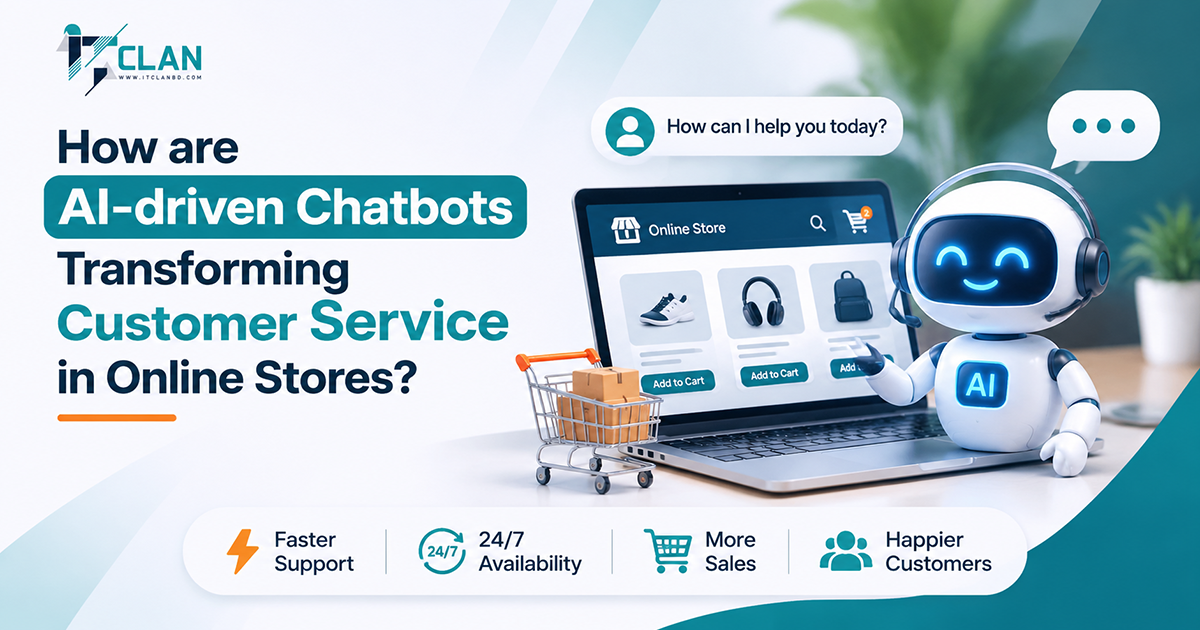
AI-driven chatbots are transforming customer service in online stores by answering routine questions around the clock, helping shoppers compare products, retrieving order updates through connected systems, and collecting details before a human takes over. Their value depends on accurate store information, secure integrations, and an easy route to a person when a problem needs judgment.
For a store owner, the change is practical: customers can get help while they are shopping, and support staff can spend less time repeating delivery and returns information.
But adding a chat window does not automatically create better service. A bot that replies immediately with the wrong return policy creates another problem. The goal is to resolve suitable questions accurately and pass everything else to the right person.
An AI customer service chatbot is a conversational interface that helps shoppers ask questions in everyday language. Depending on its design, it can retrieve approved information, query store systems, or guide a customer through a defined support process.
IBM describes ecommerce chatbots as tools used across customer support, product discovery, and post-purchase assistance. Its overview also distinguishes conversational interfaces from agents that can perform broader tasks through connected tools.
When planning a store chatbot, separate three capabilities:
| Capability | Example | What the system needs |
| Answer an information question | “What is your return window?” | Current, approved store policies |
| Retrieve live information | “Has my order shipped?” | A secure order-system connection and customer verification |
| Perform an action | “Start a return for this item.” | Authorized tools, policy checks, confirmation, and escalation rules |
A chatbot connected only to a help center should not claim to know whether a specific parcel has shipped. A system that can read an order should not automatically have permission to refund it.
Shoppers do not always browse when your support team is available. A chatbot can answer approved questions about delivery coverage, payment methods, or product care after staff have signed off.
For example, a shopper might ask whether cash on delivery is available in their area. The bot should check the store’s actual coverage rules and request a location if needed.
If the question requires staff, it should explain when a person can respond. Around-the-clock automated assistance should come with clear expectations about human availability.
Questions about delivery fees, return conditions, and order status can occupy the same team members repeatedly. Automating suitable enquiries gives staff more room to investigate missing parcels, damaged items, and unusual requests.
Start with your own support history. Group recent questions by topic and identify those with clear answers, reliable data, and few exceptions.
Do not judge success only by how many chats avoid a human. A customer who gives up after several irrelevant replies has not received a useful resolution.
An order-tracking chatbot can save customers from searching confirmation emails or waiting for an agent to check a dashboard.
The important requirement is a connection to the relevant order or carrier system. The bot should distinguish between “order received,” “packed,” “handed to courier,” and “delivered” using the available records.
If the courier has not supplied a delivery estimate, the chatbot should say that. It should never invent a date to make its answer sound complete.
This also depends on reliable stock and order records. Our guide to common inventory management challenges explains problems that can make customer-facing information unreliable.
A shopper asking for a lightweight backpack under a certain budget may need more help than a category filter provides.
A chatbot can ask about intended use, compare verified specifications, and link to relevant product pages. For a compatibility question, it should request the exact device model rather than guessing.
This makes complete product information essential. Follow these e-commerce product page best practices to give shoppers and your support system clear specifications, limitations, and buying information.
Product recommendations should reflect the customer’s requirements. Recommending an available alternative can be helpful; repeatedly promoting unrelated products can interrupt the conversation.
A returns conversation often starts with missing information: the order number, purchase date, item condition, or reason for return.
A chatbot can explain the published process and collect those details. With an appropriate integration, it may also create a return request after checking eligibility and receiving confirmation.
Opening a request is different from approving a refund. Keep exceptions and disputed cases with authorized staff.
When the process includes ticket creation, approval routing, and notifications, AI workflow automation services can connect those steps around the conversation.
Customers should not have to repeat an entire conversation when they ask for a person.
A useful handoff includes a concise issue summary, verified order reference, relevant policy, checks already completed, and the customer’s requested outcome. Staff should also be able to inspect the original conversation.
AI can assist the staff reply as well. Shopify’s documentation, for example, describes suggested replies as a writing aid that staff should review and edit for accuracy before sending. That is a different function from autonomous customer support.
Repeated questions can show where your website needs improvement.
If shoppers repeatedly ask whether an item includes a charger, update the product page. If customers misunderstand the return window, clarify the policy and checkout information.
Review recurring questions, unanswered requests, and escalations regularly. Updating the underlying information helps future shoppers, including those who never use the chatbot.
Choose the smallest system that can handle the task reliably. Product labels overlap, so evaluate the actual integrations, permissions, and behavior.
| Approach | Suitable starting use | What to check |
| Rule-based chatbot | Fixed choices, contact collection, simple FAQ flows | Can shoppers reach an answer without getting trapped in menus? |
| AI chatbot | Open-ended questions answered from approved store information | Does it retrieve the right information and acknowledge missing answers? |
| AI agent | Multi-step tasks using connected systems | Are actions restricted, logged, and routed for approval when needed? |
| Human support | Disputes, exceptions, and situations requiring judgment | Does the agent receive the conversation context and authority to help? |
For conversational support, explore ITclan BD’s AI chatbot development services. If your requirement includes looking across systems and coordinating actions, AI agent development services may be more relevant.
They can, but results depend on your support volume, data quality, implementation costs, and customer experience.
An NBER working paper, Generative AI at Work, studied an AI assistant used by 5,179 customer support agents. It reported a 14% average increase in issues resolved per hour. This was assistance for human agents, not evidence that an autonomous ecommerce chatbot will produce the same result.
For your store, use a calculation based on actual work:
Estimated monthly capacity value = enquiries genuinely resolved by automation × average manual handling minutes ÷ 60 × loaded hourly support cost.
Consider this hypothetical example:
| Item | Illustrative figure |
| Enquiries resolved through automation | 600 per month |
| Manual handling time per enquiry | 4 minutes |
| Staff capacity released | 40 hours |
| Loaded support cost | $12 per hour |
| Estimated capacity value | $480 |
| Monthly operating and maintenance costs | $200 |
| Remaining capacity value before setup costs | $280 |
These are hypothetical figures, not ITclan BD client results.
Freed staff time becomes cash savings only if it changes paid hours or avoids additional hiring. Otherwise, it provides capacity for other work.
For sales, compare eligible sessions in a controlled test where possible. Shoppers who use chat may already have different purchase intentions, so a higher purchase rate among chat users alone does not prove the bot caused the increase.
The most damaging failures involve inaccurate answers, exposed account information, unauthorized actions, and frustrating handoffs.
| Risk | Practical control |
| Invented policies or promises | Retrieve approved information; escalate when the answer is missing |
| Stale prices or availability | Query the appropriate live system and handle unavailable data explicitly |
| Exposure of another customer’s order | Enforce authentication and record-level authorization in the application |
| Unapproved refunds or account changes | Limit tool permissions; require confirmation and approval where appropriate |
| Repeated irrelevant replies | Offer human help and define escalation triggers |
| Misunderstood languages or product names | Evaluate real customer wording and route unclear requests to staff |
OWASP identifies prompt injection, sensitive information disclosure, and excessive agency as risks for language-model applications. For a store, these risks make application-level access controls and restricted actions essential; instructions written into a chatbot prompt are insufficient protection.
For a Bangladesh-focused store, evaluate the language customers actually use, including Bangla, English, and Bangla written in Latin letters.
Here is an illustrative test conversation, not a claim about a deployed ITclan BD system:
Customer: “Ei shoe ta size 42 ache? Dhakar baire COD hobe?”
The chatbot should identify two requests: size availability and cash-on-delivery coverage. It should check the selected product variant and ask for the delivery location before confirming payment eligibility.
If the customer then asks, “Amar ager order ta koi?”, the bot should switch to a verified order lookup. It should not infer order ownership from the conversation alone.
Include spelling variations, mixed-language messages, and requests for a person in your evaluation. A tool advertised as multilingual still needs testing against your store’s actual conversations.
Start with an enquiry category that has clear answers and enough volume to measure.
For example, begin with delivery policy questions before introducing account changes or refund actions.
Assign owners for delivery rules, return policies, product specifications, and help content.
If two pages describe different return windows, resolve the conflict before connecting them to your chatbot.
Confirm what your ecommerce platform exposes through apps or APIs.
This guide to choosing an e-commerce platform covers integration considerations.
Document what the bot may read, what it may change, and when a person must take over.
Make the human-support route visible, including when agents are offline.
Test real enquiry patterns, missing data, failed connections, unauthorized requests, and human handoffs.
Include questions that the chatbot should decline to answer or escalate.
Compare results with a baseline and review failed conversations before expanding.
You do not necessarily need to train a new AI model. Depending on the use case, an existing model connected to approved knowledge and store tools may be sufficient. Our overview of integrating AI into custom software provides broader implementation context.
Track these measures during the pilot:
| Measure | What it helps you understand |
| Verified resolution rate | Whether eligible enquiries are actually resolved; define a follow-up window and audit a sample |
| Answer accuracy | Whether replies match approved policies and current records |
| Repeat-contact rate | Whether customers return with the same unresolved problem |
| Human handoff completion | Whether requests for a person reach a staffed queue |
| Customer satisfaction | Whether customers find the experience helpful; compare automated and human support |
| Total cost per resolved enquiry | Whether software, staff review, maintenance, and allocated setup costs justify the outcome |
Define pilot targets before launch. A fast first response is useful, but it cannot compensate for an unresolved enquiry.
Start with one customer problem your team can measure. Identify the information it requires, the systems it touches, and the point at which a person should take responsibility.
ITclan BD can help scope the chatbot, integrations, and human handoff around that process. Discuss your online store’s support workflow with ITclan BD.
It can handle suitable routine enquiries, but stores still need people for exceptions, complaints, sensitive decisions, and quality review. The appropriate balance depends on the support tasks and the system’s demonstrated reliability.
Yes, when it has the necessary integrations and authorization. Order tracking requires secure access to current records. Starting a return requires policy checks and permitted actions; refund approval may remain a human responsibility.
They can be useful when repetitive enquiries consume enough staff time to justify setup and ongoing costs. For a low-volume store, clearer FAQs, fixed automated answers, or live chat may be a more economical starting point.
Costs depend on conversation volume, model usage, channels, integrations, language requirements, testing, and ongoing maintenance. Compare total operating costs and setup work against measurable support outcomes rather than looking only at the subscription price.
Not necessarily. Retaining chat history, using conversation context, and training a model are separate processes. Improvement usually requires reviewing failures, updating approved information, and testing changes under an explicit data-handling policy.
Quality Is Our Strength
AI-driven chatbots are transforming customer service in online stores by answering routine questions around the clock, helping shoppers compare products, retrieving order updates through co...
Custom software can help your business prepare for BFCM 2026 by automating tasks, managing inventory, improving website performance, connecting business systems, and creating a smoother cus...

Halloween brings more than costumes, candy, and spooky decorations. It can also bring extra website visitors, online orders, searches, and sales. But if your website is slow, broken, confus...