Web Development
25 Feb, 2026


Our Blog Details
Home / Our Blog Details
Web users today are impatient, and honestly, for good reason. With so many fast apps and platforms available, nobody wants to wait for slow websites that take forever to load or break on mobile screens. People expect smooth, instant, and reliable digital experiences everywhere they go online.
That growing expectation is exactly why Progressive Web Apps, or PWAs, are becoming a major part of the future of web development. They bring together the reach of websites and the performance of mobile apps into one powerful solution.
A Progressive Web App is a modern type of website that behaves like a mobile application. You can open it in your browser just like any normal website, but it works faster, feels smoother, and can even be installed on your device.
The biggest difference is that users do not need to go to an app store. With one click, the website becomes an app-like experience directly from the browser. PWAs are built using modern web technologies that focus on performance, reliability, and user engagement.
PWAs are designed to fix common problems people face with traditional websites. They improve speed, reliability, and engagement while keeping things simple for users.
One of the main reasons PWAs are so popular is how fast they load. Even on slow mobile networks, pages appear almost instantly, which keeps users from leaving. They also allow users to interact with websites even when the internet connection is weak or unavailable.
• Instant loading through smart caching that stores key content for faster access.
• Offline browsing support, allowing users to access important pages without internet connection.
• Smooth navigation without page reloads for a fast and app-like browsing experience.
• Push notifications for updates that keep users informed, engaged, and returning regularly.
• Home screen installation, letting users open the website just like a mobile application.
To learn how responsive design plays a key role in delivering smooth experiences across all devices, which is a foundational principle for successful PWAs, check out our guide on Responsive Web Design Trends: Future-Proof Your Site.
Businesses today compete heavily for online attention. A slow or confusing website can easily push customers away within seconds. PWAs help companies provide faster experiences while spending less compared to building separate mobile apps. They also allow businesses to reach both web and mobile users with a single platform.
User experience is one of the most important ranking and success factors today. Users no longer need to wait for pages to reload constantly. Everything feels quick and responsive. Even in areas with poor internet connections, users can still access content easily. Progressive Web Apps greatly improve user experience by making websites faster, smoother, and easier to use, which is now a major factor for both success and search rankings.
With PWAs, users no longer have to wait for pages to reload again and again because everything feels quick, responsive, and seamless. They offer clean, mobile-friendly layouts that adapt perfectly to any screen size and provide app-like interactions that feel modern and engaging. Even in areas with weak or no internet connection, users can still access important content through reliable offline support.
When browsing becomes this smooth and hassle-free, users feel more satisfied, trust the website more, and are far more likely to return. For more strategies on enhancing digital experiences through modern web technologies, check out our post on Maximizing User Experience with Advanced Web Development Techniques.
Many businesses struggle to choose between websites and mobile apps. PWAs simplify this decision by combining the best of both. Traditional websites are easy to access but often slow and limited. Native apps are powerful but expensive and time-consuming to develop.
PWAs offer a smart middle ground. Let’s see the core differences between them.
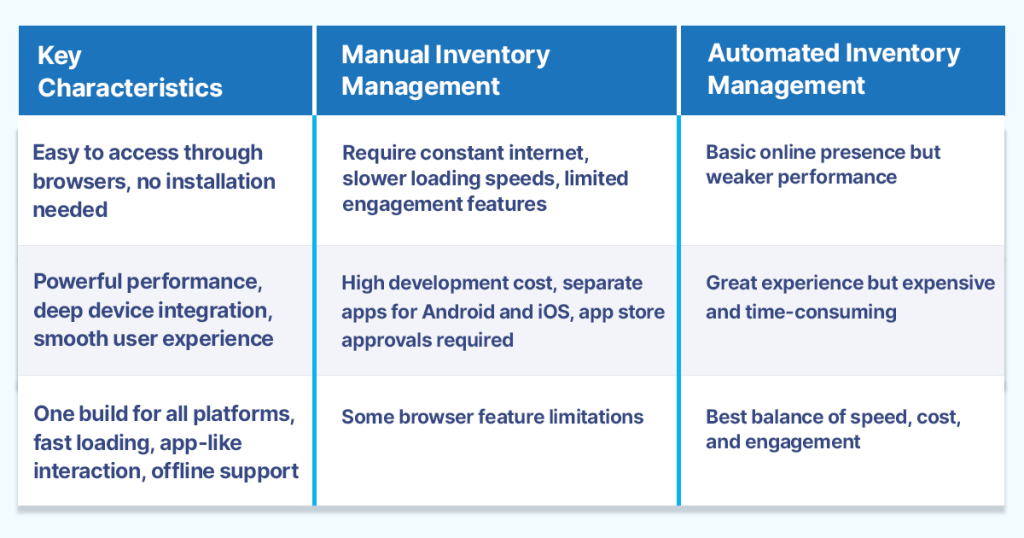
PWAs are changing how developers design and build websites today. Speed and performance are no longer optional; they are required. Developers now focus more on user behavior, mobile experience, and loading speed from the beginning. Websites are no longer treated as simple pages but as full digital applications.
This shift is raising the overall quality of the modern web. Websites today are becoming faster, smarter, and more user-focused than ever before. As developers adopt PWA-driven practices, users enjoy smoother experiences while businesses see better performance and engagement.
PWAs are a great fit for most modern businesses, especially those that rely heavily on mobile users and online engagement. Industries like online shopping, service-based websites, SaaS platforms, education portals, and content-driven sites benefit the most because PWAs offer speed, accessibility, and smooth user experiences across all devices.
However, highly complex applications such as mobile games, hardware-dependent tools, or graphic-heavy apps may still perform better as native mobile apps. For the majority of businesses though, PWAs strike the perfect balance between performance, cost, and user convenience.
To explore how web development contributes to long-term growth and scalability, check out our article on Web Development for Scalable Business Growth.
Although PWAs are powerful, they still have some limitations. Some mobile platforms limit certain features, and browser support can vary. However, these issues are improving every year.
Common limitations:
Overall, the benefits far outweigh the challenges. Just like PWAs have technical limitations that businesses must plan around, avoiding common digital pitfalls is equally important for growth. We break this down clearly in 10 Digital Marketing Mistakes to Avoid for Your Business Growth.
PWAs are becoming a standard part of modern websites rather than an extra feature. Browsers continue adding more support, making PWAs even stronger. Businesses are also realizing the long-term value of this technology.
Adopting PWAs does not require rebuilding everything from scratch. Most websites can gradually add PWA features. The key is focusing on speed, mobile experience, and performance.
Working with experienced developers ensures the best results. Before upgrading your site with PWA features, it’s helpful to understand the investment side too — our guide on Cost to Build a Website breaks down what businesses should expect when improving performance, design, and functionality.
If you’re thinking about upgrading your website into a high-performance Progressive Web App, working with the right development team makes all the difference. ITclan BD specializes in modern web development solutions focused on speed, user experience, and business growth, helping companies build fast, secure, and scalable PWAs tailored to their goals. From performance optimization to mobile-first design and ongoing support, ITclan BD ensures your PWA not only looks great but also delivers real results for traffic, engagement, and conversions.
Progressive Web Apps are reshaping the web by making it faster, more reliable, and more user-friendly. They help businesses grow online while giving users smoother and better digital experiences. If you want your website to stay competitive in the future, embracing PWA technology is one of the smartest decisions you can make.
Progressive Web Apps are often a better choice for businesses that want fast performance without high development costs. They work across all devices using a single platform, while native apps require separate development for Android and iOS. For most websites, e-commerce stores, and service platforms, PWAs provide excellent speed, engagement, and flexibility without the complexity of traditional apps.
Yes, one of the biggest advantages of PWAs is offline functionality. They store important content using smart caching, allowing users to browse even when the internet is slow or unavailable. This is especially useful for mobile users and regions with unstable connections.
PWAs can be very SEO friendly when built properly. They load faster, improve mobile experience, and meet Google’s Core Web Vitals standards, which helps boost search rankings. Since PWAs are still websites at their core, search engines can easily crawl and index their content.
PWAs usually cost much less than building native mobile apps. Instead of creating separate versions for different platforms, developers build one solution that works everywhere. This reduces development time, maintenance costs, and future update expenses.
Yes, most modern websites can be upgraded into Progressive Web Apps without rebuilding everything. Developers can add PWA features like offline support, faster caching, and installable options step by step. This makes PWAs a practical and affordable upgrade for many businesses.
Quality Is Our Strength

A good e-commerce product page should make it easy for shoppers to understand a product, trust your store, and take action. From clear product images and useful descriptions to fast loading...
Have you ever wondered why some businesses always seem to appear on Google while also getting plenty of likes, shares, and comments on social media? Here's the thing! They're not relying on...

Running a small business today is more competitive than ever. People search online first before visiting a store or hiring a service, and if your business isn’t visible in local search re...