Agree on the input, expected output and who uses the result. Decide which mistakes are most important to catch.


Trusted by Business Partners Worldwide

E-Learning Platform

E-Learning Platform

CRM

Real Estate

Insurance

E-commerce

Real Estate

Learning

Medicine

E-commerce

E-commerce

E-Learning Platform

Property Landing

Mobile Apps

E-Learning Platform
Types of AI Models We Build and Adapt
Start with the output you need. That could be a stock forecast, a category for an incoming request or a warning that a product image needs a closer look.
Plan Your First Model Test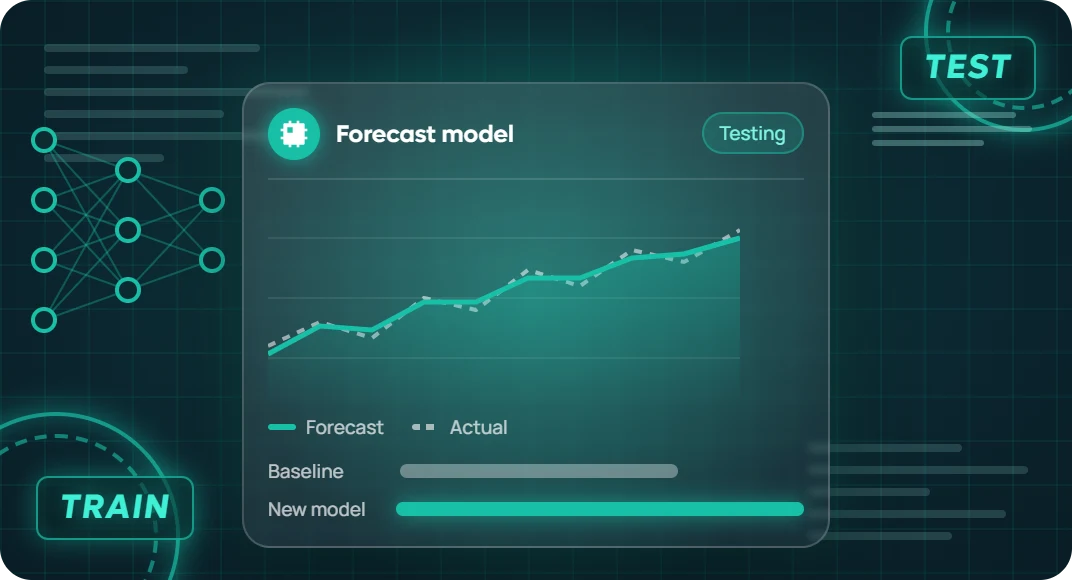

Demand Forecasting Models
Use historical sales and relevant signals such as promotions to estimate demand. Compare forecasts with a simple seasonal baseline on later periods your model has never seen.

Text Classification Models
Sort support tickets, emails or documents into agreed categories. Test which categories are often confused and send uncertain cases to a reviewer.

Document Extraction Models
Pull fields such as invoice numbers, line items and totals from different document layouts. Measure accuracy field by field so your team can see where manual checks still matter.

Computer Vision Models
Identify visible defects or check whether items appear in product images. Test on images that reflect real lighting, camera angles and the defects your team needs to catch.

Recommendation Models
Suggest relevant products or content using available catalog and interaction data. Compare recommendations with a simple popularity-based list and plan for new users with little history.

Anomaly Detection Models
Flag unusual records or patterns, such as an unexpected change in order volume. Tune alert thresholds with the people who review the flags so routine variation does not overwhelm them.

Fine-Tuned Language Models
Adapt a pretrained language model when a task needs more consistent behavior, such as returning the same structured fields across varied inputs. Compare the result with the existing model using the same test examples.

Smaller Models for High-Volume Tasks
Test whether a smaller model can handle a narrow task like classifying enquiries. Compare its quality, response time and cost per record at the volume you expect.
Why Develop Your AI Model With ITclan BD?
Agree on What Better Means
We choose a comparison point before training. That might be your current model, a rule your team uses or a simple forecast. The test shows whether a tailored model improves a result that matters to you.
Test on Cases the Model Hasn’t Seen
We set aside examples for evaluation and include difficult cases. For invoice extraction, that could mean low-quality scans or layouts from suppliers absent from the training examples.
Plan How the Model Will Be Used
We consider the software and people around the model. For example, an extraction model may need an API, a review screen for uncertain results and a way to track which model version produced an output.
Our Approach to Custom AI Model Development Services
We start with the task, the data you can use and the cost of getting a prediction wrong. Those details guide how we test and deploy the model.
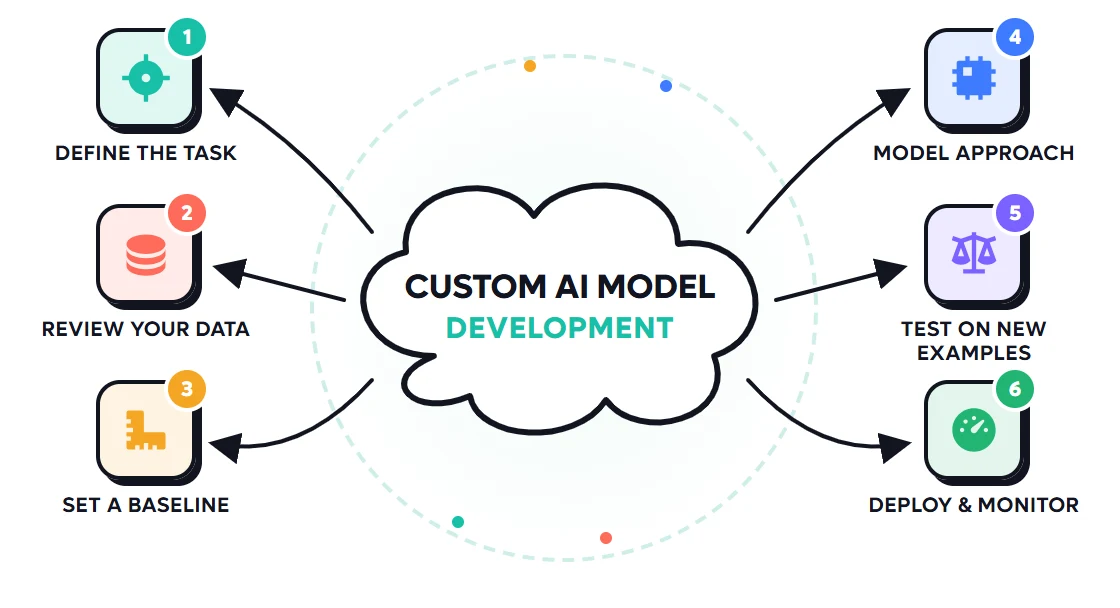
Compare a purpose-built machine learning model, an existing pretrained model or fine-tuning where appropriate. If the problem is access to current reference material, test retrieval as an option.
Check available examples, data quality and permissions. Identify where labels, missing cases or inconsistent formats could limit the first test.
Evaluate with examples held back from training and tuning. Check the errors your team cares about alongside response time and estimated running costs.
Measure how your current rules, process or existing model performs. Use that result as the benchmark for more work.
Agree on where the model runs, how the application sends inputs, who reviews unexpected results and when a model update should be considered.
How We Develop and Deploy Your AI Model
Where a Custom AI Model Can Help First
Idea
Compare Against Your Current Process
Test a candidate against what your team uses today to see where it improves results and where it still struggles.
Work
Cut Down Repeated Data Entry
Extract agreed fields from documents and flag the ones a reviewer should check.
Team
Prioritize the Right Alerts
Tune an anomaly detector with the people who review its alerts, using examples of issues they would act on.
Goal
Check Running Costs Before Scaling
Measure response time and cost at expected usage, alongside the quality your workflow needs.
Custom AI Model Development Pricing
Your quote depends on the task, data quality, labelling needs, training approach and deployment requirements. We can separate development costs from ongoing model usage, hosting and support.

Model Feasibility and Benchmark
Custom Quote
Based on project scope
What’s included
Model Training or Fine-Tuning Pilot
Custom Quote
Based on project scope
What’s included
Production Model Development
Custom Quote
Based on project scope
What’s included
Model Feasibility and Benchmark
Custom Quote
Based on project scope
What’s included
Model Training or Fine-Tuning Pilot
Custom Quote
Based on project scope
What’s included
Production Model Development
Custom Quote
Based on project scope
What’s included
Frequently Asked Questions
What are custom AI model development services?
Custom AI model development services cover preparing data, building or adapting a model, testing its performance and making it available to an application or workflow. The project may start with a feasibility test before training or deployment.
Do I need to train a model from scratch?
Many projects can start with an existing model or a simpler machine learning approach. We compare those options on your task first. Training from scratch is a separate decision based on the data, required performance and resources available.
What’s the difference between fine-tuning and RAG?
Fine-tuning adapts a model using examples of the behavior you want. Retrieval-augmented generation (RAG) gives a model relevant information at the time it answers, such as a passage from an updated policy. A project can use both when it needs task-specific behavior and current source material.
How much data do I need to start?
It depends on the task and how varied the inputs are. Start with representative examples and, where possible, the expected outputs. We review coverage and quality before estimating the work. If key cases are missing, we can help define what to collect or label first.
How will we know if the model works?
We compare it with a baseline using examples held back from training and tuning. The measure depends on the task. A forecast might use error on later periods, while invoice extraction might track field accuracy and how often staff need to correct the result.
Can the model run in our own environment, and who owns it?
We can assess deployment in your cloud or another agreed environment based on the model licence, infrastructure and data requirements. The scope should specify which deliverables you receive, including code, documentation and model weights where the licence and provider allow.
How much does custom AI model development cost and how long does it take?
Testing one task with clean sample data takes less work than preparing a new dataset and deploying a model into several systems. We estimate cost and timing after reviewing data readiness, training needs, the required quality and how the model will be deployed.
Will the model need retraining after launch?
It may if new inputs differ from the training data or if your process changes. Monitoring and periodic quality checks help you decide whether to refresh the data, adjust the model or keep the current version.
Best Service ✳ 5.0 (24k+ Reviews)
Testimonials from Our Business Partners
I continue to be impressed by ITclan work. What a wonderful work, They have created master pieces for me, thanks.

Have worked with ITclan before, and will again. Everything was done as instructed and they even helped solve an issue that was not originally specified clearly enough in the order.

A pleasure to work with ITclan BD, not only did a great job but put up with all my questions, issues and concerns. Will be using them again and again.

You made it so simple. My new site is so much faster and easier to work with than my old site. I just choose the page, make the change and click save. Thanks, ITclan BD!

ITclan BD's owner and his team understand in a short time what exactly you want. Has a very experienced team. Communication is very good

"ITclan BD has been a pleasure to work and collaborate with for nearly 8 months. They are a talented team and their communication is spot on. I look forward to working with them on many more."

What Do You Need Your AI Model to Do?
Tell us what goes into the task, what a good result looks like and where your current approach struggles. We’ll discuss what to test first.