Tell us who does the work today, where they get stuck and what a better result would look like. We use that to define the first release.


Trusted by Business Partners Worldwide

E-Learning Platform

E-Learning Platform

CRM

Real Estate

Insurance

E-commerce

Real Estate

Learning

Medicine

E-commerce

E-commerce

E-Learning Platform

Property Landing

Mobile Apps

E-Learning Platform
Types of AI Products We Build
What should AI help your users do? Explore the product types below. Each card shows a problem you might recognize and an example of what we could build to solve it.
Plan Your First AI Build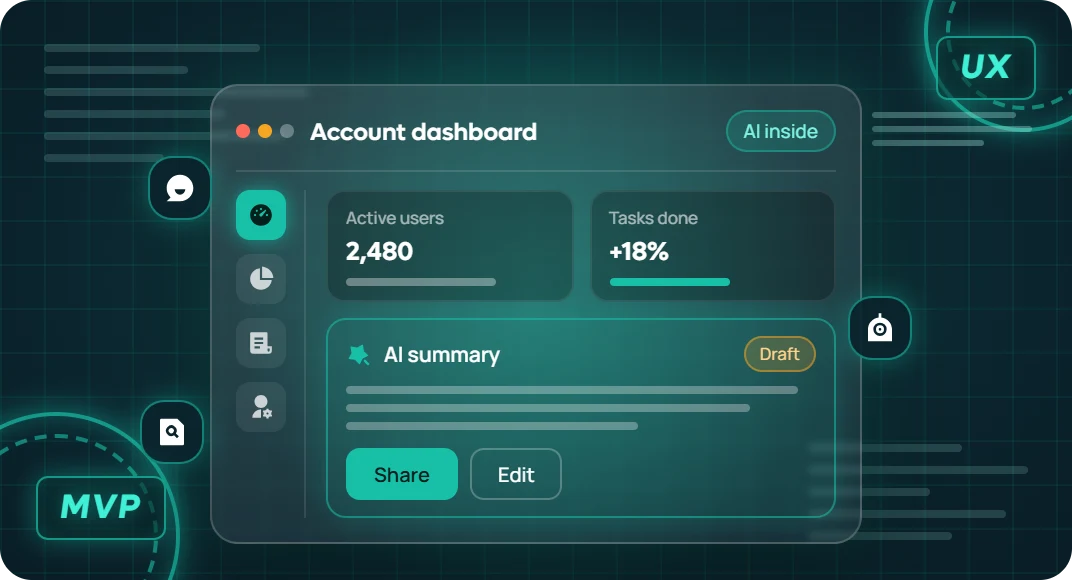

AI-Powered SaaS Platforms
When users spend too long turning activity into reports, build a SaaS product that summarizes account data and drafts updates they can edit before sharing.

AI Features for Existing Apps
When users switch tools to complete a task, bring AI into the screen they already use. For example, add a case-summary feature to a service portal so staff can review a request faster.

AI Chatbots
When customers keep asking the same questions, build a chatbot that answers from approved help articles and hands off account-specific or unresolved requests to support.

AI Copilots
When support staff search multiple tools before replying, give them a copilot that drafts a response from order details and return policies. Staff review the draft before sending.

AI Search and Knowledge Tools
When answers are buried across documents, build a knowledge assistant that searches approved policies and links to relevant sources. It can ask for clarification when the available material is incomplete.

Document Processing Applications
When finance staff retype invoice details, build an app that extracts the fields and flags missing or uncertain values. A reviewer checks the results before they go into the accounting system.

AI Agents and Workflow Applications
When sales teams copy inquiries into a CRM, build an agent that extracts lead details, checks for possible duplicates and prepares a record update for approval.

AI MVPs for New Ideas
When you need to learn whether customers will use a new feature, launch one workflow for a small group. For example, let sellers generate listing drafts and track how often they edit and publish them.
Why Build Your AI Product With ITclan BD?
Product Design and Engineering Together
A useful AI feature needs an interface, data access and a way to handle mistakes. Our software and SaaS experience helps us plan those pieces together. ITclan BD’s product portfolio includes FullStro, an e-commerce and inventory management platform.
Tested With Inputs That Resemble Real Work
If your demo behaves well on clean examples but fails on actual requests, we can test incomplete files, unclear questions and unusual inputs before rollout. We agree on what should happen when the system is unsure.
A First Release You Can Evaluate
We define what belongs in the first build and how you’ll judge it. Depending on the workflow, that might mean fewer invoice corrections, faster support replies or more users completing a task.
Our Approach to AI Product Development Services
We start with what your users need to accomplish. Then we decide what the AI should handle, what people should review and what the product must connect to.
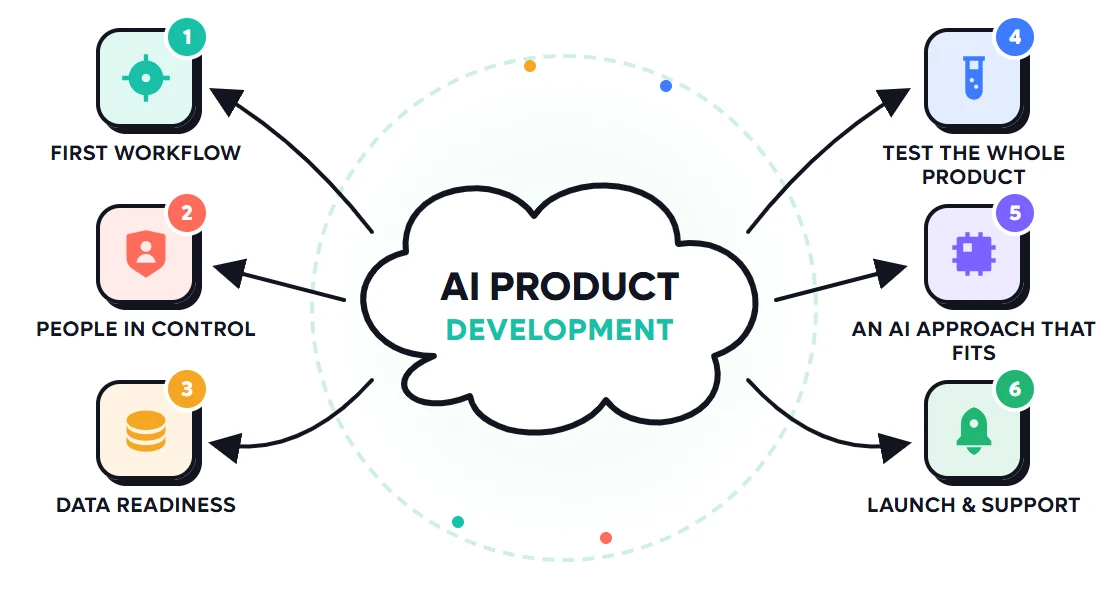
We decide where users can edit, approve or reject an output. For actions that affect customer records or financial data, the workflow can require human approval.
We review sample inputs, available data and access rules. This helps reveal missing information, inconsistent formats or restrictions that could affect the build.
We check the AI output and the surrounding application. That includes what happens when data is missing, access is denied or an integration fails.
We compare an existing model, answers grounded in your documents, and a tailored model where relevant. The choice depends on quality, response time, privacy needs and expected usage cost.
We define release criteria, documentation and handover. If you need monitoring or improvements after launch, we scope that work with you.
Workflow for Our AI Product Development Services
Explore What Your AI Product Could Do
Idea
Make Information Easier to Find
Give employees a way to search approved policies and verify answers at the source.
Work
Reduce Manual Data Entry
Extract details from forms or invoices and give staff a clear review step before saving.
Team
Help People Respond Faster
Draft support replies using relevant order details and policies so staff can review them in one place.
Goal
Test a New Product Feature
Launch one AI workflow to a small group and measure whether users complete the task or come back to use it again.
AI Product Development Pricing
Choose the scope that matches where you are today. Your quote depends on the workflow, available data, integrations and launch requirements. Model usage, hosting and ongoing support can be itemized separately.

AI Proof of Concept
Custom Quote
Based on project scope
What’s included
AI MVP Development
Custom Quote
Based on project scope
What’s included
Custom AI Product or Feature
Custom Quote
Based on project scope
What’s included
AI Proof of Concept
Custom Quote
Based on project scope
What’s included
AI MVP Development
Custom Quote
Based on project scope
What’s included
Custom AI Product or Feature
Custom Quote
Based on project scope
What’s included
Frequently Ask Questions

What are AI product development services?
AI product development services cover planning, designing, building, testing and launching software that uses AI for a specific task. The project can start with a feasibility test, an MVP or a feature inside an existing product.
What types of AI products can you build?
We can scope AI-powered SaaS and apps, chatbots, copilots, document review tools, knowledge search and agents that act across approved systems. The right product depends on what users need to do and what data they can access.
Should I start with a proof of concept or an MVP?
Start with a proof of concept if you need to see whether AI can perform the task with your inputs. Start with an MVP if the approach is feasible and you want real users to try the core workflow.
Can you add AI to my existing software?
Yes. We review your current app, available APIs and data permissions, then scope where the AI feature fits. Examples include document search, summaries and assisted drafting.
Do I need a custom AI model?
Many products can start with an existing model. If answers need to use your documents, the app can retrieve relevant passages for the model. We consider fine-tuning or custom training when testing shows a clear need.
How will you handle private data and unreliable answers?
We agree on what data the AI may access, who can view outputs and what may be sent to the provider. For uncertain or sensitive results, the application can request more information, show supporting sources or route the task to a reviewer.
What affects the price and timeline?
The biggest factors are the number of workflows, data readiness, integrations, review requirements and how much software already exists. Share sample inputs and your target launch date so we can estimate the first phase and discuss ongoing costs.
Can you support the product after launch?
Post-launch support can be included in the project scope. We’ll agree on who monitors the application and how fixes, AI quality reviews and feature improvements are handled.
Best Service ✳ 5.0 (24k+ Reviews)
Testimonials from Our Business Partners
I continue to be impressed by ITclan work. What a wonderful work, They have created master pieces for me, thanks.

Have worked with ITclan before, and will again. Everything was done as instructed and they even helped solve an issue that was not originally specified clearly enough in the order.

A pleasure to work with ITclan BD, not only did a great job but put up with all my questions, issues and concerns. Will be using them again and again.

You made it so simple. My new site is so much faster and easier to work with than my old site. I just choose the page, make the change and click save. Thanks, ITclan BD!

ITclan BD's owner and his team understand in a short time what exactly you want. Has a very experienced team. Communication is very good

"ITclan BD has been a pleasure to work and collaborate with for nearly 8 months. They are a talented team and their communication is spot on. I look forward to working with them on many more."

Have an AI Product Idea? Let’s Talk.
Tell us who the product is for, what they need to do and what you already have. We’ll discuss what to build or test first.